
Let’s be clear: SEO is very much alive — but it’s not what it used to be. If you’re still thinking about SEO like it’s 2015 (stuffing keywords and chasing backlinks), it’s time to update your playbook.
In 2025, search engines have evolved, and so have people. We ask Google questions like we’re texting a friend. AI tools give answers right on the search page. And “zero-click” results? They’re not the future — they’re already here.
So, what does that mean for you, the business owner? You don’t need to master algorithms or write like a coder. But you do need to understand how search works now — and more importantly, how your customers use it. That’s where this guide comes in. No jargon, no fluff — just practical insights to help your website stay visible in a shifting digital world.
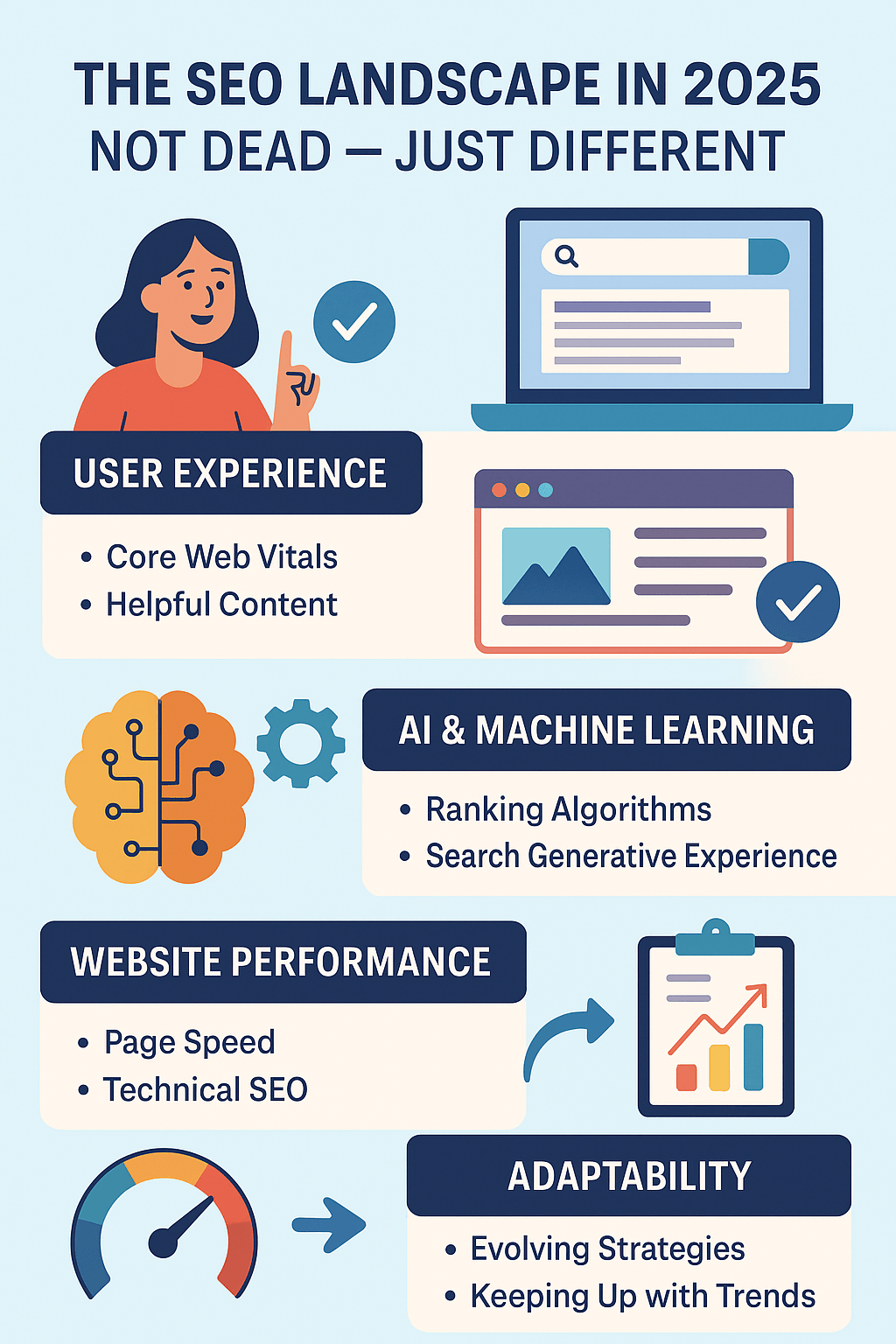
The SEO Landscape in 2025: Not Dead — Just Different
Every year, someone declares “SEO is dead.” They’re wrong — again. People still make billions of searches every single day. The difference? The way those searches work — and what gets shown — has changed.
Let’s break it down:
- Users Are Searching Differently.
More than ever, Google answers people’s questions right on the results page — no clicks needed. Voice assistants are answering out loud. AI summaries are popping up instead of plain links. That’s a game-changer for how your business gets traffic. - The Algorithms Keep Evolving.
Google updates its algorithm constantly — many changes are powered by AI that understands context, not just keywords. That means content that once ranked well might now be buried. Staying visible means keeping up with what’s rewarded now: relevance, clarity, and authority. - Quality > Quantity.
In a web full of auto-generated fluff, Google is raising the bar. It’s prioritizing content that’s genuinely helpful, written with care, and backed by trust. That brings us to a concept you’ll hear a lot in 2025: E-E-A-T (more on that in a bit).
Bottom line? SEO isn’t gone — but lazy, outdated SEO definitely is. What’s replaced it is smarter, sharper, and more aligned with what real users want.
SEO Fundamentals That Still Matter
High-Quality, Relevant Content
Let’s not overcomplicate it — content is still king. If you consistently answer your audience’s questions with clear, useful information, you’re doing better than most.
In 2025, it’s not just about having content. It’s about matching the intent behind a search. Ask yourself: What is this person really trying to solve when they Google this? Then deliver that answer — directly and helpfully. If someone searches “best running shoes,” don’t show them just your brand — show them what the top options are and why. Google notices when people stick around because they got what they needed.
High-quality, useful content is more important than ever – businesses need a solid content strategy to rank well.
Keywords & Search Intent
You still need keywords, but forget the old “stuff it in as many times as you can” trick. Google’s smarter than that now.
Today, it’s about topics, not just phrases. Use the language your customers use. Include long-tail keywords — those longer, specific phrases like “affordable ergonomic office chairs for back pain.” They may bring fewer clicks, but the people who search those terms are ready to act.
Think of keywords like seasoning. You want them in the mix, but not overpowering the whole dish.
On-Page SEO Basics
This is the low-hanging fruit. Make sure every page has a clear, meaningful title and a helpful description. Use headings to organize your thoughts — it’s good for humans and search engines.
Don’t force keywords. Write like you’d explain something to a smart friend. And don’t ignore images — descriptive file names and alt text help Google “see” what your page is about. Plus, it’s just good accessibility practice.
Backlinks and Authority
In a world drowning in content, backlinks are like word-of-mouth referrals. But in 2025, it’s no longer about how many people mention you — it’s about who does.
One good link from a respected source is worth more than 50 spammy ones. So ask: what can you publish that’s so useful others want to reference it? That could be a guide, a checklist, or original research. Be someone others turn to — and they’ll start linking to you naturally.
Technical Health & User Experience
Think of your website like a storefront. It could have the best products inside, but if the doors don’t open, no one’s getting in.
Make sure it’s easy to navigate. That it loads quickly. That it works perfectly on a phone. These aren’t “extra credit” anymore — they’re the baseline. Google wants users to have a good time, and if your site frustrates them, it’s game over. Use tools like PageSpeed Insights and Mobile-Friendly Test to keep it tight.
Content Quality and E-E-A-T: Building Trust in Your Brand
One of the biggest game-changers in SEO lately? A mouthful of a concept: E-E-A-T — which stands for Experience, Expertise, Authoritativeness, and Trustworthiness.
Don’t worry, this isn’t just corporate speak. Think of it this way: Google’s trying to figure out if you actually know what you’re talking about, and whether people should trust you. In a world full of generic, AI-churned content, proving that you’re a real, credible voice makes all the difference.
Experience & Expertise
People trust content when it feels lived-in — like it came from someone who’s actually done the thing, not just read about it. That’s what “Experience” means here.
So if you’ve run your business for years, talk about it. Share lessons. Drop in a personal story. Mention a client result (with permission, of course). Show that you’ve been there — not just Googled it.
Google wants to surface voices that bring something real to the table. If you’re a CPA writing about tax prep, for example, noting your credentials and experience doesn’t just boost credibility — it helps your content rank.
Authoritativeness
This one’s about reputation. Are you seen as a trusted voice in your field? Do others quote or reference you?
Links from respected sites are a signal to Google that you’re someone worth listening to. But it’s not just about backlinks — being cited in articles, guest posting on reputable blogs, or getting quoted by media outlets all help establish authority.
Tip: start local. A mention from your city’s business journal or an industry partner’s website is gold as Local SEO remains crucial if your customers are in a specific area.
Trustworthiness
If people don’t trust your site, neither will search engines.
That means accurate, current information. Sources cited. HTTPS encryption. Clear contact info. Real team bios. Customer reviews. An actual About page that shows you’re a legit business. These “small things” build credibility fast.
And if your business touches on money, health, or legal topics (called YMYL — Your Money or Your Life), these trust signals aren’t just nice to have. They’re essential. Google scrutinizes that content more heavily because misinformation can be dangerous.
Why E-E-A-T Matters
Let’s face it — there’s a tidal wave of content out there now, much of it AI-generated or regurgitated. Google is trying to sort out who’s for real.
If your content doesn’t show clear signs of being created by an experienced, trustworthy human (or brand), it might not get much visibility. You don’t need to be a famous expert — just someone who shows up with value, honesty, and a genuine perspective.
Easy Wins to Boost Your E-E-A-T:
- Add author bios with real credentials or experience blurbs.
- Highlight reviews and testimonials.
- Link to trusted sources when citing facts.
- Create a press page or list of places you’ve been featured.
- Don’t be afraid to show personality — people trust people, not faceless content.
Being trustworthy isn’t just a ranking factor — it’s good business.
AI-Generated Content: Use It, Don’t Abuse It
AI has officially moved in — not just into tech circles, but into the day-to-day work of writing blogs, social captions, product descriptions… all of it.
So the big question is: Does Google hate AI content?
Short answer? No.
Longer answer? It depends on how you use it.
Google’s Stance on AI Content
Back in 2023, Google came out and said it clearly:
“We reward helpful content — regardless of how it’s made.”
That means AI isn’t off-limits. If the final product is useful, accurate, and brings value to the user, it can rank just fine. The problem starts when AI is used as a shortcut to flood the web with bland, repetitive content.
So no — AI isn’t bad. But laziness is.
How to Use AI the Right Way
Think of AI like an intern. It can help you brainstorm, outline, even draft. But would you ever let an intern publish something under your name without editing it? Probably not.
Use AI to speed up, not replace. Let it handle the repetitive stuff — then you jump in to inject personality, stories, strategy, and polish. Add your human edge.
Here’s how smart business owners are using AI right now:
- To draft rough blog posts → then rewrite key parts with original insight
- To generate FAQs or ideas → then curate and format for tone + clarity
- To summarize research → then add commentary, interpretation, or context
If you can’t tell whether your own article sounds generic… your readers (and Google) definitely can.
What Not to Do
Avoid the temptation to hit “generate” and publish as-is. Here’s why:
- AI can hallucinate — make up facts, misstate details, or plagiarize unintentionally.
- Google is getting better at spotting content that’s too robotic or “empty.”
- Users will bounce fast if the writing feels lifeless or disconnected.
Publishing generic AI content doesn’t just hurt rankings — it damages trust. And once people tune you out, they rarely come back.
The Hybrid Approach Wins
Want to scale content without losing authenticity? Blend the two:
- Let AI draft the bones
- Then add flesh and soul
Google will reward you. Readers will connect. And you’ll save time without sacrificing quality.
Search Generative Experience (SGE): The New AI-Powered Search Results
Meet SGE — Google’s latest shake-up to how search works. Instead of just a list of links, you now sometimes see an AI-generated summary right at the top of the search page.
It’s kind of like asking a super-smart assistant a question — and getting a full paragraph answer instantly, without clicking anything. Welcome to the future of search.
What This Means for Searchers
Google’s goal is clear: reduce friction.
So now, when someone searches a complicated question, they might see a summary generated by AI that pulls info from multiple sources. Think:
- quick definitions
- step-by-step guides
- mini overviews
No more bouncing between five sites to piece together an answer. SGE brings the answer to you.
What This Means for Your Business
Here’s the obvious concern:
If Google answers everything on the search page… will anyone still click?
Fair question — but not the whole story.
SGE is still evolving, and it doesn’t show up for every search. But it does mean this:
👉 You want your content to be good enough that Google’s AI quotes you.
So while fewer people might click “just to check,” more will see your content quoted at the top — which still builds visibility and trust.
How to Optimise for SGE (and AI-Powered Results)
Here’s how to show up in AI summaries:
Answer Questions Clearly
Write content that directly addresses common questions in your niche. Think FAQ-style formats or blog posts titled “How to [X]…” or “What is [Y]…”.
Start with the question, then answer it right away in 2–3 sentences before going deeper.
Use Smart Formatting
Break up content using:
- Bulleted lists
- Step-by-step instructions
- Descriptive subheadings
Why? AI tools love structure — it helps them pull and summarize more effectively. It also makes content easier for real humans to read.
Cover Topics Thoroughly
Don’t be a one-post wonder. Instead, build clusters of related content.
Example: if you sell electric bikes, don’t just write one blog post. Write about:
- maintenance tips
- safety gear
- comparisons by price
- environmental benefits
That’s called building topical authority — and SGE loves it.
Use Strong Visuals
SGE often includes images or media alongside text summaries. So:
- Use crisp, context-relevant images
- Add descriptive alt text
- Include charts, infographics, or demo visuals where applicable
Great visuals can earn you a spot in those results — even if your text doesn’t get quoted.
TL;DR on SGE:
You may get fewer clicks per search, but higher visibility overall. So don’t panic — just evolve.
The businesses that win in the SGE era will:
- Focus on user-first content
- Create deep, helpful resources
- Make sure their site is easy to understand — by humans and machines
Mobile-First and User Experience: No Longer Optional
Let’s be real: most people are glued to their phones. That includes your customers.
In fact, by early 2024, over 65% of global searches happened on mobile. So Google made it official — it now uses the mobile version of your website to decide how you rank. If your site doesn’t work well on phones? Google will likely treat it like it doesn’t exist.
Mobile-Friendly Design
Your website needs to feel just as smooth on a phone as it does on a laptop. That means:
- Text that’s easy to read without zooming
- Buttons that don’t require surgical precision
- Layouts that adjust automatically to screen size
Common mistakes? Menus that are hard to tap. Overlapping elements. Tiny fonts. These things frustrate users — and they make Google back away too.
Pro tip: run your site through Google’s Mobile-Friendly Test. It’s free, fast, and eye-opening.
Site Speed & Core Web Vitals
Online, slow = gone. Users won’t wait more than a few seconds. Google knows this — and now factors it into rankings using something called Core Web Vitals.
In simple terms, these measure:
- How fast your page loads
- How soon users can interact with it
- Whether things stay stable as the page builds
If your layout jumps around while loading or your buttons take forever to work, you’re going to lose people.
Easy wins:
- Compress your images
- Remove bulky pop-ups
- Enable caching
- Keep your design clean and fast
Bonus: faster sites don’t just rank better — they convert better, too.
Navigation & Structure
Imagine walking into a store where nothing’s labeled. No signs. No aisles. Just clutter.
That’s what a poorly structured website feels like.
Make your navigation obvious. Use clear menus. Link between related pages so users can dive deeper. For example:
- Blog posts should link to your services
- Product pages should link to FAQs
- “Contact Us” should be easy to find from everywhere
The easier it is for people (and search engines) to find what they need, the longer they’ll stick around — and the better your site will perform.
Security & Trust Signals
People are more cautious than ever online. That means you need to look trustworthy right away.
Start with basics:
- Use HTTPS (that little padlock in the URL bar)
- Have a clear About Us page
- Show real contact info
- Include reviews, testimonials, or even trust badges (like “BBB accredited” or “Member of [industry group]”)
These things might not directly boost rankings, but they boost confidence — and that leads to clicks, conversions, and good SEO vibes all around.
Bottom Line: UX = SEO
In 2025, user experience is search engine optimization.
Google’s AI is smart enough to sense what feels human-friendly. If your site annoys or confuses people, they’ll bounce — and you’ll drop in rankings. If it’s fast, clear, and helpful? Google will reward you.
So think less like a robot… and more like a user.
Voice and Visual Search: Optimizing for How People Search Now
Search isn’t just typed anymore. People are talking to devices and snapping pictures to find what they need. And in 2025, if you’re not thinking beyond the keyboard, you’re leaving money on the table.
Voice Search: Speak Their Language
With smart speakers, smartphones, and cars now answering questions aloud, voice search is everywhere. And it’s growing — over 1 in 5 people use voice search regularly.
Most voice queries sound different than typed ones. People speak in full, natural sentences like:
- “Where can I get my taxes done near me?”
- “What’s the best way to fix a leaky pipe?”
- “What time does [your business] close today?”
Voice searches are longer, more conversational, and often local.
How to Get Found in Voice Search:
Use Q&A Format
Anticipate what your customers ask — then answer it directly on your site.
A clear FAQ page or blog posts that start with “How do I…” or “What is…” go a long way.
Write How You Talk
Ditch the jargon. Use everyday language. If your answer sounds like something you’d actually say out loud, you’re on the right track.
Optimize for Featured Snippets
Voice assistants often pull answers from the “snippet” box on Google — that little summary at the top. To win one, pose the question in your heading, and answer it clearly in 2–3 sentences right after.
Claim Your Local Listings
Update your Google Business Profile. Make sure your hours, phone number, and location are accurate — because “near me” searches heavily rely on this data.
Visual Search: Let Pictures Do the Talking
More and more users — especially younger ones — are using their camera as a search tool.
Apps like Google Lens let people take a picture of something — a product, a place, even a logo — and search based on that image. This is huge for retail, travel, food, fashion, and local businesses.
How to Get Found in Visual Search:
Use High-Quality Images
Blurry photos won’t cut it. Upload crisp, well-lit images that clearly show your product, space, or service. Use multiple angles if relevant.
Name Your Image Files Smartly
Instead of “IMG_00123.jpg,” use something like “red-suede-sneakers-2025.jpg.”
This helps Google understand what’s in the image.
Write Strong Alt Text
Alt text is like a description for your image — it helps with accessibility and search. Don’t just write “shoes.” Write “red suede sneakers with white soles.” Be specific.
Use Structured Data (If You’re Up for It)
If you run an e-commerce site, adding structured data (aka schema markup) to your product pages gives Google more info to pull for search — including images, pricing, and availability.
Think Beyond the Keyboard
The key takeaway? People are using more ways to find information. So your content — and your website — needs to show up whether they:
- Speak into their phone
- Snap a photo
- Or still type like it’s 2010
Optimising for voice and visual search isn’t just future-proofing — it’s now-proofing.
The Rise of Zero-Click Searches: Staying Visible When Users Don’t Click
You’ve probably noticed it yourself: sometimes you Google something, and the answer pops up before you even click anything.
That’s a zero-click search — when Google answers the question right on the results page with a snippet, a map, a calculator, or even a product listing. And yep, they’re more common than ever.
So what does this mean for your business?
It means not every search will lead someone to your site — but that doesn’t mean you’re out of the game.
How to Win Without the Click
Aim for Featured Snippets
These are the little info boxes at the very top of search results — also known as “Position Zero.” If someone’s going to get credit for answering a question without a click, let it be you.
To increase your chances:
- Write in Q&A format
- Use clear, short answers (2–3 sentences)
- Include lists, tables, or step-by-step instructions where appropriate
Build a Recognizable Brand
Even if users don’t click, they’ll see your name. And if they see it often, they’ll start to trust it.
When your site is cited as the source of a snippet, or when your business pops up in a Google Map or Knowledge Panel, people take note. Consistent exposure builds familiarity. Familiarity builds trust.
Trust gets clicks eventually — just not always immediately.
Embrace a Multi-Channel Strategy
SEO doesn’t live in a vacuum. If fewer clicks are coming through Google, balance it out by:
- Growing your email list
- Showing up consistently on social media
- Posting YouTube videos, podcasts, or LinkedIn articles
- Being active in relevant communities or groups
All of this builds up your visibility — and keeps you from being totally dependent on search traffic.
Treat Google’s Ecosystem Like It’s Yours
Some zero-click features are actually opportunities in disguise.
- Your Google Business Profile can appear in maps, panels, or voice queries — optimize it like you would a landing page.
- Your products might show up in Google Shopping.
- Your YouTube content can get featured in video carousels.
You don’t always need the click to make an impression — you just need to be present where attention is going.
Final Thought on Zero-Click:
This isn’t the end of SEO. It’s just a shift in what “visibility” looks like.
Sometimes, the win is the click.
Sometimes, the win is the impression.
Sometimes, the win is brand recall that pays off later.
If you’re part of the answer — even if the user doesn’t visit your site right away — you’re still in the game.
Key Takeaways for Business Owners
Let’s bring it home. SEO in 2025 isn’t rocket science — but it is different.
Here’s what to focus on:
SEO Isn’t Dead — But Lazy SEO Is
The rules keep changing, but the core remains: if you create helpful content that people enjoy and search engines understand, you’ll do just fine.
E-E-A-T Is Your Secret Weapon
Show your experience, expertise, authority, and trustworthiness. Google is hungry for credible sources. Be one.
Use AI — But Keep It Human
Let AI help you brainstorm and draft, but always add your unique insight, tone, and truth. That’s what earns attention (and rankings).
Get Seen in New Search Formats
Optimize for voice. Use visuals. Structure your content for snippets and summaries. Visibility now comes in more forms than just a blue link.
Mobile and UX Matter More Than Ever
A fast, clean, mobile-friendly website isn’t optional. It’s your foundation. Fix the basics and everything else works better.
Be Agile, Not Perfect
SEO isn’t a one-time checklist. It’s a mindset. Stay curious, test things, and adapt. You don’t need to chase every trend — just keep showing up with value.
Track What Counts
Use tools like Google Search Console and Analytics to see what’s working. Measure what matters: not just traffic, but leads, sales, engagement — whatever drives your actual business.
In the end, SEO is still about being useful, visible, and trustworthy — just with a bit more AI in the mix.
You’ve got this!
References:
- Landis, H. (2025, February 12). Essential SEO Best Practices for Online Success in 2025. Taboola Marketing Hub.
- O’Brien, S. (2024, December 9). State of SEO in 2025: Trends and Predictions. Leadfeeder Blog.
- Stephan, A. (2025, May 2). 6 SEO Trends for 2025 You Should Know. SEO.com.
- Google Search Central. (2023, February 8). Google Search’s guidance about AI-generated content [Blog post].
- Google Search Central. (n.d.). Mobile site and mobile-first indexing best practices. Retrieved 2025, from Google Developers website: https://developers.google.com/search/docs/crawling-indexing/mobile/mobile-first-indexing
- Kumar, N. (2025, May 8). 68 Voice Search Statistics 2025 (Usage Data & Trends). DemandSage.
- Digiligo. (2023, February 14). Google Search February 2023 Product Review & AI Content Update. Digiligo Blog.
- Search Engine Journal. (2024, April 24). Google E-E-A-T: What Is It & How To Demonstrate It For SEO (M. G. Southern, Author).