Choosing the right domain name and web hosting service can be a turning point for your business’s digital identity. Whether you’re launching a new venture, rebranding, or expanding your online footprint, understanding how these elements work is essential to making informed and cost-effective decisions. In today’s digital-first environment, your website is often the first impression potential customers will have. That makes it critical to choose your domain and hosting services wisely—with both functionality and growth in mind.
Understanding the Role of a Domain Name
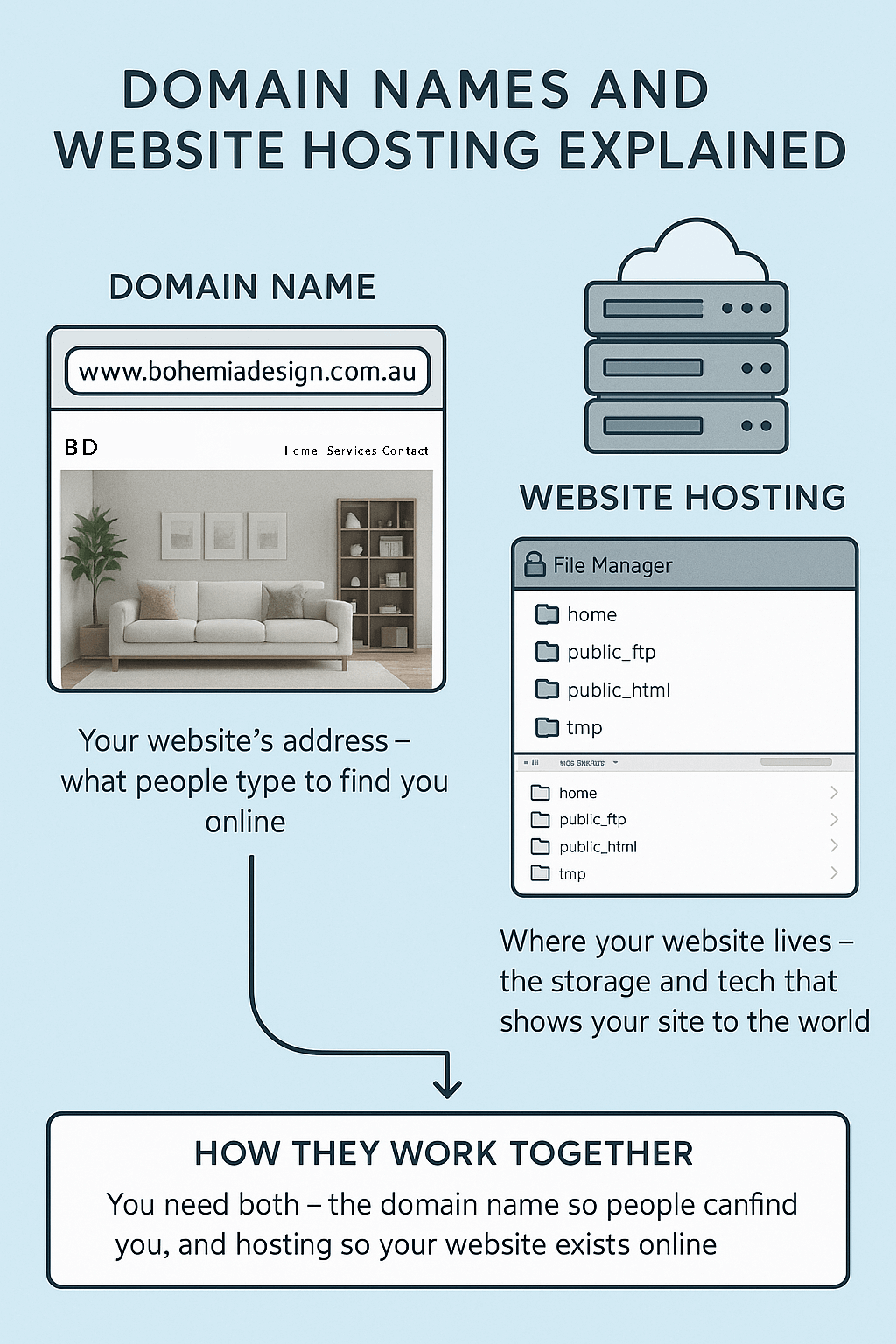
A domain name is more than just a digital address. It represents your brand, your mission, and the first point of contact many users will have with your business. In simple terms, a domain name is the human-readable version of your website’s IP address. Instead of a long string of numbers, users type in something memorable like www.yourbusiness.com. Domain names are registered through accredited registrars and require annual renewal. If you fail to renew, you risk losing your domain and potentially your brand identity online.
From a branding perspective, the domain name should be short, easy to spell, and reflective of your business. Names that are too complex or unrelated to your business can harm credibility and searchability. Domain extensions also matter. While .com remains the most recognized and trusted, regional extensions like .com.au or industry-specific options such as .tech or .store can convey additional relevance and trustworthiness. If your business serves a specific region, a country-specific domain (like .com.au) can benefit Local SEO.
There’s also a legal angle to consider. Registering a domain name that infringes on another business’s trademark could land you in hot water legally, so conducting a proper trademark search before purchasing a domain is a prudent step.
Beyond branding and legality, domain names play a role in user experience. For example, if a user can’t remember your domain or frequently mistypes it, you risk losing traffic to competitors. This is why many businesses also buy alternative spellings, hyphenated versions, or plural/singular variations and redirect them to their main domain. Doing so helps capture all traffic that may result from typographical errors and provides a smoother journey for users.
Additionally, businesses should be aware of the risks associated with expired domains. There is a lucrative market for expired domains with existing traffic, and cybercriminals often purchase lapsed domains to engage in phishing or impersonation attacks. Setting up auto-renewal and maintaining ownership records are basic but essential practices.
Hosting: The Engine Behind Your Website
Web hosting is the service that allows your website to be accessible on the internet. When someone visits your domain, the hosting provider delivers your site’s content from their servers to the user’s browser. Hosting involves storing your website’s files, ensuring uptime, security, and site performance. In short, hosting is the invisible infrastructure that keeps your website live and functional.
There are several types of hosting available, and the one you choose should align with your business needs, traffic expectations, and budget. Shared hosting is an economical option suitable for small sites, but it comes with limited resources and slower speeds. VPS (Virtual Private Server) hosting offers a middle ground with better performance and more control. Dedicated hosting is ideal for high-traffic websites and offers maximum customization and reliability. Finally, cloud hosting is known for scalability and is increasingly becoming the go-to option for startups expecting growth.
Website Security and uptime are two critical features to assess when choosing a host. A host should offer SSL certificates, firewalls, and malware protection to safeguard your site. Uptime guarantees of 99.9% or higher are a sign of reliability, indicating that your site will remain accessible to visitors most of the time.
Also important is server location. If your audience is primarily based in Australia, choosing an Australian website hosting provider with data centres located within the country can significantly improve load times. For global businesses, some hosts offer content delivery networks (CDNs) that cache your site on servers around the world, minimizing latency and enhancing performance regardless of user location.
Support is another essential factor. Look for hosts that provide 24/7 customer support with multiple contact channels including live chat, phone, and email. For non-technical users, good support can mean the difference between a quickly resolved issue and prolonged website downtime. A responsive, knowledgeable support team is often more valuable than minor pricing differences between providers.
.
Australian Considerations: Local or Global?
For Australian businesses, it’s worth considering a .com.au domain, which signals local relevance and authenticity. Eligibility to register a .com.au domain requires having a valid Australian Business Number (ABN) or Australian Company Number (ACN), making it more credible to local consumers. Studies show that users are more likely to trust and engage with websites using their country code top-level domain (ccTLD) due to perceived security and local affiliation.
Local web hosting is another factor to think about. Australian website hosting with a data centre located in Australia can offer faster load times for local visitors. It can also help with data sovereignty—ensuring customer data remains subject to Australian laws, an important concern in industries like healthcare, legal services, and finance.
Additionally, businesses that choose local hosts may benefit from region-specific support hours, payment systems in AUD.
Making Smart Domain Choices
Smart domain choices begin with availability and branding. Before committing to a name, brainstorm keywords that reflect your industry and unique value proposition. Tools like NameMesh or Domainr can help generate ideas based on availability. Once you’ve chosen a name, register it through an ICANN-accredited registrar to ensure compliance with global standards.
It’s often a good idea to purchase multiple domain extensions or misspellings to prevent cybersquatting or user error. For instance, securing both yourbrand.com and yourbrand.com.au can help funnel traffic correctly and protect your brand equity. Redirecting these domains to your main site ensures visitors always end up in the right place.
Also consider registering domains that represent future offerings or company divisions. This pre-emptive approach can be a valuable strategic asset. For example, if you intend to expand into different services or launch a podcast, securing those domain names now—even if you don’t plan to use them immediately—can prevent others from capitalizing on your future growth.
Another strategy is to include your business name and a keyword in the domain. For example, if your business is called “Bright Path” and you offer coaching services, a domain like brightpathcoaching.com can immediately signal what you do to users and search engines alike.
Hosting Providers: What to Look For
Choosing a hosting provider should never be based solely on price. The cheapest host may lack essential features like regular backups, fast customer support, or security monitoring. Prioritize providers that offer comprehensive service packages including SSD storage, CDN integration, and 24/7 support.
Reputation matters. Look for providers with positive reviews and a proven track record. Evaluate the provider’s scalability options too. As your site grows, you’ll want the flexibility to upgrade your hosting plan without downtime or disruption. Your hosting also plays a huge role in load times – as our domain & hosting guide notes, choosing a quality host can significantly improve your site’s speed.
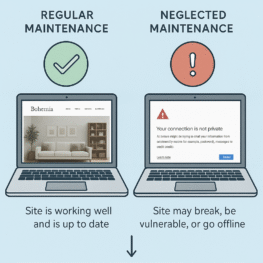
Most quality hosting providers also include free SSL certificates, which are now a standard requirement for secure browsing and SEO performance. A site without HTTPS may be flagged by browsers and penalised by search engines.
You should also check whether the host includes automated backups, malware scanning, and DDoS protection. These services are essential for business continuity and site integrity. Data loss due to hacking or technical failure can be disastrous, particularly for ecommerce sites or those collecting customer data.
Moreover, many providers now offer managed WordPress hosting. These plans take care of updates, backups, and caching for you, which can save time and improve performance for users running WordPress sites. For small business owners with limited tech support, managed hosting can be a smart and stress-reducing investment.
SEO and Domain Names
Your domain name can influence your search engine rankings. While exact-match domains (like bestplumbersydney.com) were once heavily favoured, today’s search algorithms consider broader factors like content relevance, backlinks, and site performance. Still, having relevant keywords in your domain name can provide a small SEO advantage, especially when combined with high-quality content and proper on-page optimisation.
Short domains are generally better for SEO and branding, as they’re easier to remember, type, and share. Avoid hyphens or numbers where possible—they complicate verbal sharing and often appear less professional. In the long run, a strong domain name paired with reliable hosting can enhance your search visibility, site loading speed, and user experience, which are all crucial SEO metrics.
Google also considers site speed and uptime as ranking factors. This is where your choice of host comes into play. A fast-loading, well-maintained site can outperform competitors with sluggish websites—even if their content is slightly better.
Domain age and authority also influence SEO. While you can’t speed up domain age, purchasing expired domains with an existing backlink profile is a tactic some marketers use to jumpstart rankings. However, this strategy requires careful vetting to avoid domains with spammy histories.
Cost Considerations and Value
Be cautious of hidden fees such as renewal spikes, add-on charges for email, or domain transfer costs. Transparent pricing and upgrade flexibility are hallmarks of a reputable provider. Also, look for refund policies and trial periods that allow you to test the service before fully committing.
Investing in quality hosting and the right domain is not just about keeping your site online. It’s about ensuring speed, reliability, security, and scalability—all key factors in maintaining customer trust and business growth.
Many providers also offer promotional rates for the first year but increase fees significantly on renewal. Make sure to read the fine print and budget accordingly. For long-term projects, consider registering domains for multiple years to lock in low prices and signal commitment to search engines.
Final Thoughts: Think Long-Term
Your domain name and hosting provider are more than just technical necessities; they are strategic assets. The right domain can build credibility, enhance marketing efforts, and boost discoverability. The right hosting can provide the backbone for a seamless, secure, and fast user experience.
In making these decisions, take your time. Assess your current needs but also think about where your business will be in 2, 5, or 10 years. Flexibility, customer support, and reputation should be central to your choice of provider. A poor choice now may require costly migrations or rebranding efforts later.
If you’re unsure where to start, consult with a professional web designer or developer. Many offer domain and hosting setup services as part of their packages and can recommend trusted providers that align with your specific business model and growth trajectory.
Remember, your online presence is not just a checkbox—it’s your digital storefront, your brand’s voice, and often your most effective sales platform. Whether you’re setting up your very first website or planning to re-launch with a new look, domain and hosting decisions can shape the entire customer experience.
Your online presence starts with a name and a home. Make both count.
Reference List
auDA. (2023). Eligibility and Allocation Policy Rules for .au Domains. https://www.auda.org.au/policy/eligibility-allocation-policy-rules-au-domains
Cloudflare. (2024). What Is DNS? https://www.cloudflare.com/learning/dns/what-is-dns/
Google. (2023). Search Engine Optimization (SEO) Starter Guide. https://developers.google.com/search/docs/fundamentals/seo-starter-guide
Hostinger. (2024). Hosting Comparison and Features. https://www.hostinger.com/
ICANN. (n.d.). What Is a Domain Name? https://www.icann.org/resources/pages/what-2012-02-25-en
Moz. (2023). Domain Authority: What You Need to Know. https://moz.com/learn/seo/domain-authority
Namecheap. (2023). How to Choose a Domain Name. https://www.namecheap.com/blog/how-to-choose-a-domain-name/
NameMesh. (2024). Startup Company Name Generator. https://www.namemesh.com/
OECD. (2022). Cybersecurity and Digital Economy. https://www.oecd.org/digital/
SiteGround. (2024). Web Hosting Plans. https://www.siteground.com/web-hosting.htm
SSL.com. (2023). What is an SSL Certificate? https://www.ssl.com/faqs/what-is-an-ssl-certificate/
VentraIP. (2024). Australian Web Hosting. https://ventraip.com.au/web-hosting/
WordPress.org. (2024). Choosing a Hosting Provider. https://wordpress.org/support/article/hosting-wordpress/
WPBeginner. (2023). Best Domain Name Generators. https://www.wpbeginner.com/showcase/best-domain-name-generators/
Hosting Tribunal. (2023). Web Hosting Statistics. https://hostingtribunal.com/blog/web-hosting-statistics/